| This passage, excerpted from M. Amos Clifford’s book, Your Guide to Forest Bathing, offers good tips and lovely thoughts to keep in mind on your walk…”The invitation is simple: Walk slowly [or sit still], while silently noticing what is in motion in the forest. There is always movement, even when things seem perfectly still. Strands of a web drift in the air, trees move in the breezes, birds fly by, and squirrels scramble in the branches, grasses bend, insects crawl. . . . Until you become accustomed to it, walking slowly for more than a few minutes is, paradoxically, stressful. . . Because the mind and body are a single entity, slowing our body will also calm our mind. . . . The eternal movement of the forest gives our minds something to engage with. Just as with sitting meditation the breath is always there and available for watching, in the forest there are always things in motion. Your mind will drift, and many other thoughts will arise. When they do, gently bring your attention back to noticing what’s in motion. When you find you have automatically sped up, come to a complete halt for a moment. It’s an opportunity to fully give your attention to one thing, noticing how that thing is in motion. After a brief pause you’ll be ready to continue your slow walk. I recommend that you walk like this for at least 15 minutes. That’s enough time for your mind to go through several cycles of distraction and calming. “ From M. Amos Clifford, Your Guide to Forest Bathing: Experience the Healing Power of Nature (Conari Press: 2018), 34–35. |
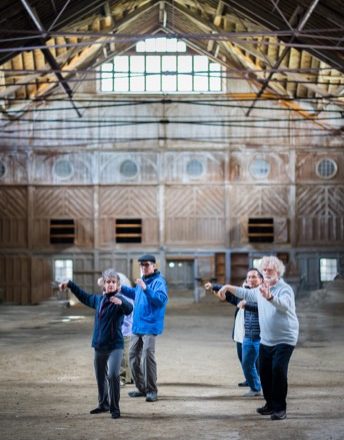
“It is a mistake to think that loss of flexibility is a necessary part of the aging process. The truth is that flexibility decreases with the number of years that the body is deprived of its full range of movement. The aging process in this regard is not related to the age of the individual but to the number of years spent in wrong or incomplete use.” The Tai Chi Book by Robert Chuckrow, PH.D. Warm up and stretching page 75
With this is mind, please wiggle your toes! You will hear me talking about the toes in class, that flexibility in the toes is what helps us keep walking instead of shuffling and ultimately keeps the joy in walking!
Practical Applications- Tai Chi in Everyday Life
When we play at Tai Chi, we strive to move slowly, smoothly, and continuously. This allows us to connect the mind and body and be aware of the spirit of the movements. We are gentle with ourselves as we learn sometimes strange postures and gradually we are gliding along stringing one after another into a dance that is relaxing our bodies and challenging our minds. With practice we apply this smooth continuous gentleness to our interactions in our daily activities.